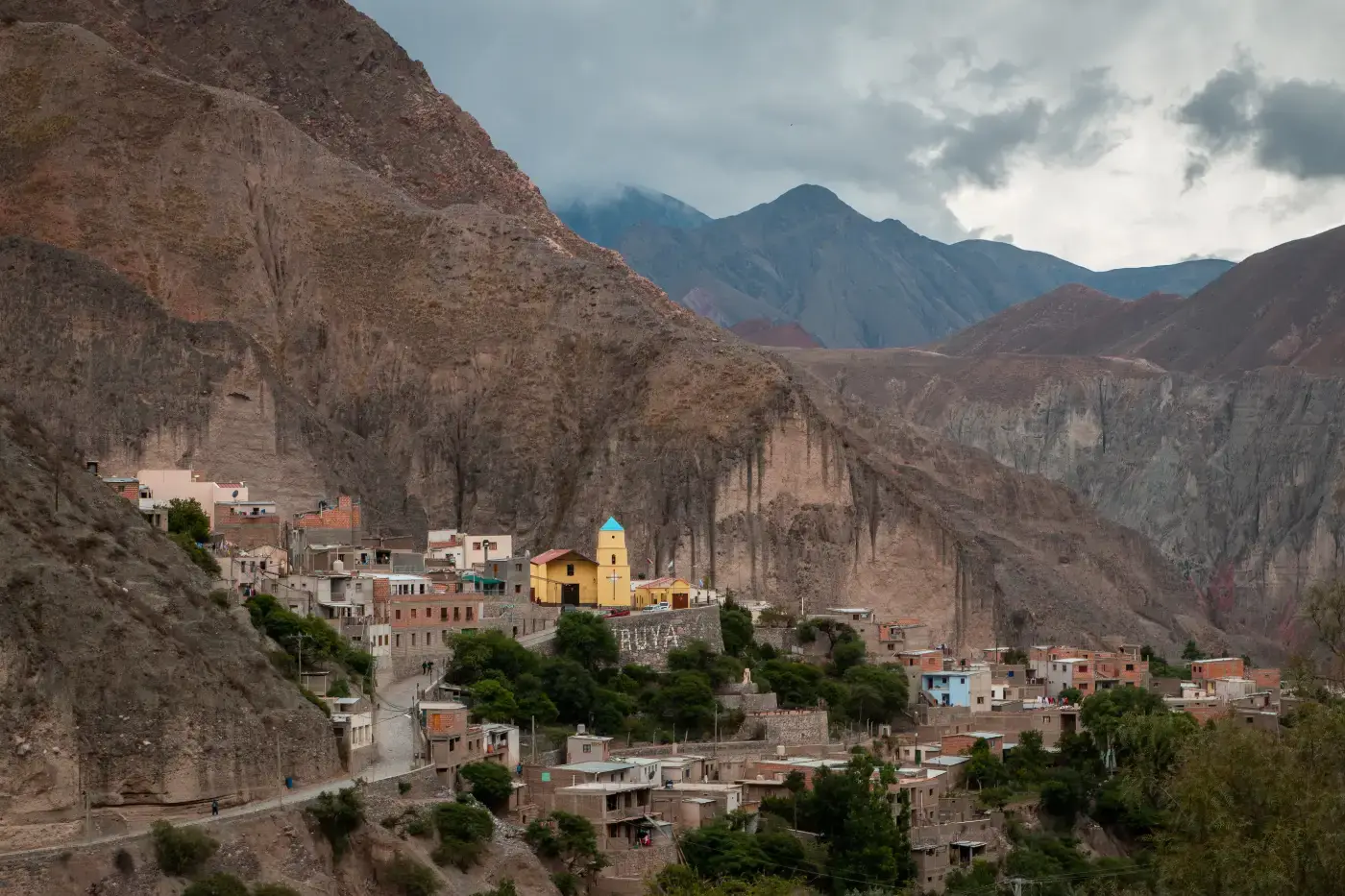
Iruya is a village in Salta province, perched on a mountainside at 2,780 m (9,120 ft), yet you reach it from neighboring Jujuy: the only road leaves Ruta Nacional 9 about 26 km (16 miles) north of Humahuaca and runs 54 km (34 miles) on gravel along provincial roads RP 13 and RP 133, crossing the Abra del Cóndor pass at about 4,000 m (13,100 ft). It is roughly 73 km (45 miles) from Humahuaca in all, around 3 hours by local bus or 2 to 2 h 30 min by car. Every bend is worth it: steep cobbled lanes, adobe and stone houses, a colonial church and riverbed hikes to hamlets such as San Isidro. Here is how to get there, what to see, how long to stay and when to avoid the rainy season.
In Salta Province, but Reached Through Jujuy
Iruya is the seat of a district of the same name in Salta province, but the mountains around it cut it off from the rest of Salta. That is why the only road access is from the Quebrada de Humahuaca on the Jujuy side: even if you start in the city of Salta, you have to drive north to Humahuaca and take the turnoff, a trip of more than 300 km (186 miles).
The village has around 1,500 residents who live from terrace farming, public jobs and, increasingly, tourism. What makes it special is the setting: houses stacked up a hillside between the Iruya and Colanzulí rivers, surrounded by huge mountains in ochre, green and violet. There is no checklist of big sights here; the point is to walk, look around and slow down.
In practice, Iruya works best as an add-on to a Jujuy trip. The easiest plan is to pair it with Humahuaca: spend the night before there, see the town and the Hornocal mountain, then leave early for Iruya the next morning. For Humahuaca itself, see our guide to what to see in Humahuaca.
Getting to Iruya by Bus from Humahuaca
The bus is the most popular way in, since it spares you the gravel driving and the ride itself is a sightseeing trip. It leaves from Humahuaca's bus terminal and takes about 3 hours.
Timetable published by Transporte Iruya in October 2026:
• Humahuaca to Iruya: 8:20 am, 10:30 am and 4:00 pm (no 4:00 pm bus on Saturdays).
• Iruya to Humahuaca: 6:00 am (not on Sundays), 1:00 pm and 3:15 pm.
• From April to November, the last bus from Humahuaca and the first one from Iruya detour via Colanzulí and take about 15 minutes longer.
Panamericano de Jujuy also runs one early-morning service from San Salvador de Jujuy through Purmamarca, Tilcara and Humahuaca, reaching Iruya around midday and heading back in the afternoon. It is handy if you are staying farther south.
In September 2026, a Transporte Iruya ticket cost about 9,500 pesos one way or 17,500 pesos return; treat that as a guide, since fares rise often. In high season, buy your ticket at the terminal the day before. The buses are basic and bags often travel on the roof, so keep a warm layer and water with you. Fares are paid in pesos, so carry cash.
Driving to Iruya: Gravel Roads and the Abra del Cóndor
If you are driving, this is the route:
• Humahuaca, km 0: fill up here, as there is no fuel on the way.
• North on RN 9 for 26 km (16 miles) of pavement to the RP 13 junction, signposted «Iruya 54 km».
• Iturbe, about 8 km later: a village with an old railway station. The gravel here is often corrugated.
• Across the Río Grande and up to the Abra del Cóndor at about 4,000 m (13,100 ft), on the Jujuy–Salta border. This is the highest point of the trip.
• Down RP 133: some 19 to 20 km in which you drop more than 1,200 m (3,900 ft) through tight bends to Iruya.
From the pass you can see hillside hamlets and the Cerro Morado, which tops 5,000 m (16,400 ft). It is the most spectacular stretch and also the most demanding: the road is narrow, with steep drop-offs, and you share it with buses. Only stop where the road widens.
You do not need a 4x4 in the dry season, but a high-clearance vehicle is strongly recommended because of loose rocks and a few river fords. Keep to 30 to 40 km/h (20 to 25 mph) and set off early so you are not driving down in the dark. If you are renting, check whether the insurance covers gravel roads; our Jujuy car rental comparison explains what to ask. And remember the pass sits at 4,000 m: if you have just arrived in the north, read up on acclimatizing to altitude first.
What to See in Iruya: Church, Viewpoints and Village Life
You explore Iruya on foot, and almost everything is uphill or downhill. The essentials:
• Church of Nuestra Señora del Rosario y San Roque: built around 1753, with a pale facade and bell tower, it stands at the entrance to the old village and is Iruya's signature view. On the first and second weekends of October, the village celebrates its patron saint festival for the Virgin of the Rosary, with processions and the traditional cachis dance.
• Mirador de la Cruz: about a 40-minute uphill walk from the center, with the best view over the village, especially at sunset.
• Lanes and main square: steep cobbled lanes, adobe and stone houses, and local women selling handwoven textiles in the square.
• Footbridge: crosses the river to the La Banda neighborhood and is the starting point for the Mirador del Cóndor hike.
• Cemetery: at the top of the village, with open views over the valley.
Eat at the village's small family-run restaurants: locro (a hearty corn and meat stew), tamales, stews and empanadas are the staples. Food is simple and filling, and in low season some places close early.
Hiking to San Isidro
This is the most popular outing from Iruya. San Isidro is a hamlet of a few houses about 8 km (5 miles) away, with no road for ordinary cars: you go on foot, on horseback or by 4x4 along the riverbed.
What to expect:
• You leave the village along the Colanzulí river and then follow the bed of the San Isidro river.
• Allow 2 to 3 hours each way, depending on your pace and the water level.
• The climb is moderate, but you cross the river several times: wear shoes you do not mind getting wet or hiking sandals, and bring sunscreen and water.
• San Isidro appears perched above a gorge, with farming terraces, a white church dedicated to San Isidro Labrador and a viewpoint by the cemetery.
Some families in San Isidro offer home-cooked meals and basic rooms, so you can stay overnight and walk back the next day. If you are traveling alone or have little mountain experience, hire a local guide or muleteer in Iruya. Always ask whether the river is passable before you set off.
Mirador del Cóndor and Other Hikes
The Mirador del Cóndor (Condor Viewpoint) is on the mountain directly opposite the village. Cross the footbridge and start climbing a steep trail. Depending on your fitness and how far you go, the way up can take one to three hours, and with luck you will see condors gliding over the valley. The gradient and altitude make it a moderate to hard hike, and going with a guide is recommended.
More ideas for a second or third day:
• Pueblo Viejo and Colanzulí: half-day 4x4 trips or horseback rides to nearby hamlets.
• Pucará de Titiconte: archaeological remains about 5 km (3 miles) northeast of Iruya, best visited with a guide.
• Horseback rides: arranged in the village to San Isidro, Pueblo Viejo or the viewpoint.
Iruya has local guides and small agencies that organize these trips; ask at your guesthouse. If you would rather book everything from Humahuaca or Tilcara, browse the tours available in Jujuy.
How Many Days to Stay and Where to Sleep
Two or three days is ideal, which is what Argentina's tourism ministry recommends: one to arrive and wander the village, one for San Isidro and, if you can, a third for the Mirador del Cóndor or another hike. A day trip is possible on the 8:20 am bus with the 3:15 pm return, but that gives you only about four hours in the village against six hours on the road.
Iruya has small hotels, hostels, family guesthouses and campsites. A few places you can find on Booking.com or their own websites:
• Hotel Iruya: at the top of the village, next to the cemetery and close to the Mirador de la Cruz, with a terrace and valley views. The most comfortable option.
• Hostal Milmahuasi: a guesthouse with a terrace, shared kitchen and both private and dorm rooms.
• Hostal Tacacho: a family-run guesthouse with breakfast, on the main square.
• El Caucillar: a guesthouse with its own restaurant.
• El Hostelito: a simple, budget-friendly choice.
Book early for July, Easter and the October festival. Bring enough cash from Humahuaca, as you cannot always pay by card. If Iruya is full, stay in Humahuaca and do Iruya as a long day trip; see our guide to where to stay in Humahuaca.
Rainy Season: When to Go and When to Avoid
The best time to visit Iruya is April to November, with dry days, clear skies and low rivers. Winter nights (June to August, the Southern Hemisphere winter) are cold and the pass can freeze, but the road is usually in good shape.
From December to March it rains most afternoons in the region, and that changes the trip:
• Rivers rise, and the fords on the road can become impassable for hours or even days.
• Storms wash mud and rocks onto the gravel, and mudslides sometimes cut off access.
• The San Isidro hike may be impossible when the river is running high.
If you go in summer, take the bus rather than your own car, set off early, leave a spare day for the return and check road conditions at the Humahuaca bus terminal before you leave. The reward is a much greener landscape. For a month-by-month look at the whole province, read our guide to the best time to visit Jujuy.
Frequently Asked Questions
Ready to travel?
Compare hotels, car rentals and tours in Jujuy.
Related Articles
Altitude Sickness in Jujuy: How to Acclimatize and Not Ruin Your Trip
Practical guide to preventing and treating altitude sickness in Jujuy. Exact altitudes, day-by-day protocol, medications and warning signs.
Read more →
Humahuaca: What to See in the Quebrada's Main Town — Square, Town Hall and Andean Carnival
Guide to Humahuaca: the Cabildo with El Señor de la Sala, Independence Monument, crafts, Andean copla singing and the most authentic carnival in northwest Argentina.
Read more →Where to Stay in Humahuaca: Hotels, Hostels, Cabins and Uquía
Hotels in Humahuaca, cabins and hostels close to the Hornocal. The best areas in town, stays in Uquía and Huacalera, and when to book for Carnival.
Read more →