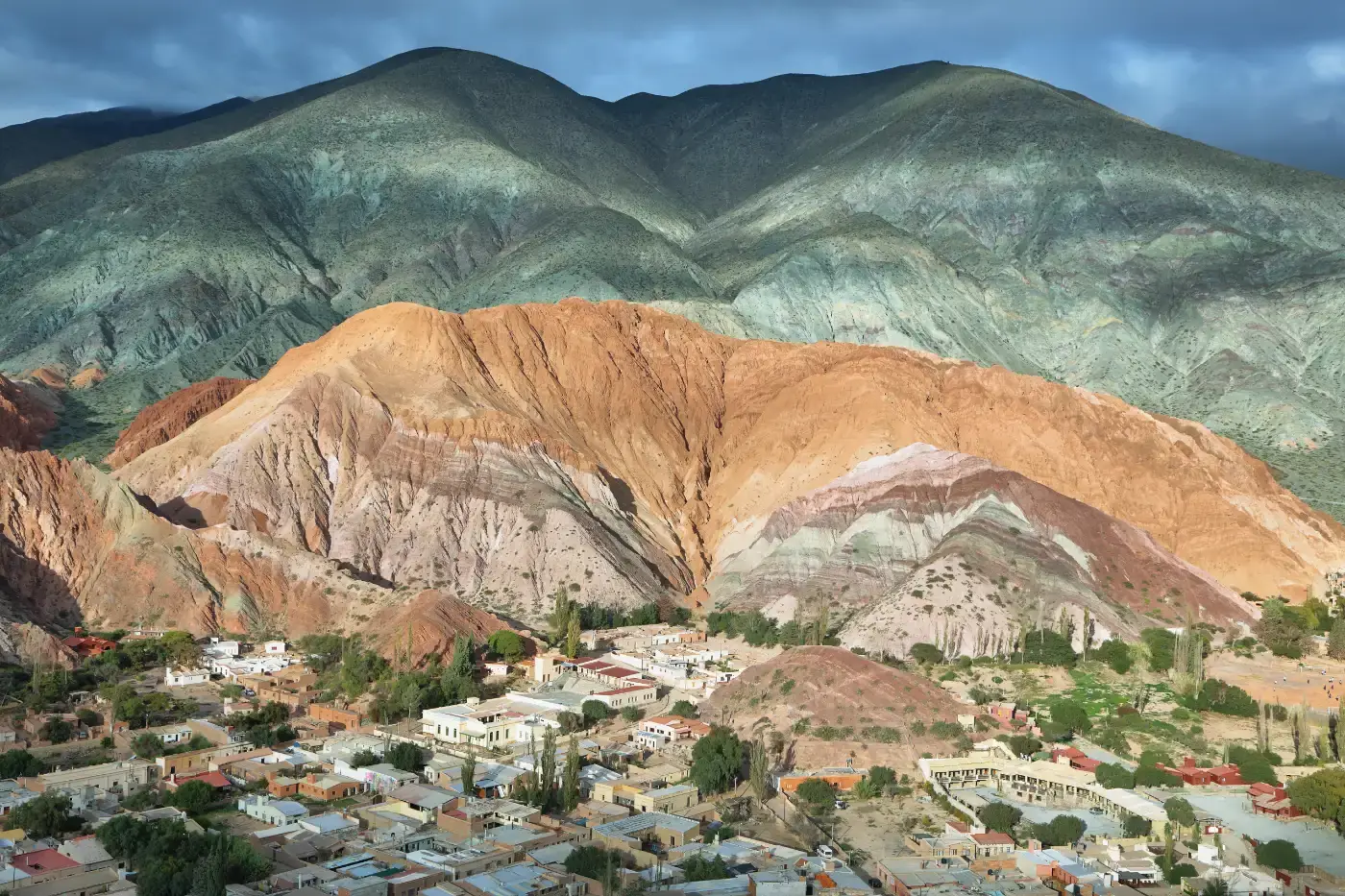
The best things to do in Jujuy, in Argentina's far northwest, center on the Quebrada de Humahuaca, a UNESCO World Heritage valley: the Seven Colors Mountain in Purmamarca, the Pucará de Tilcara ruins, the 14-colored Hornocal near Humahuaca and the Salinas Grandes salt flats over the Cuesta de Lipán pass. Add the provincial capital, cloud forest, the high Puna and festivals like Carnival and Pachamama. Below are 22 numbered highlights, with the best way to do each one, real distances and what's changed in 2026.
With extra days: Termas de Reyes hot springs, the Tren Solar, Uquía and Yavi and the Puna.
Purmamarca and the Road to the Puna (1 to 4)
Purmamarca sits 65 km (40 miles) from San Salvador de Jujuy, about an hour on RN 9 and RN 52, at 2,324 m (7,625 ft). It's the first village in the Quebrada and the jumping-off point for the salt flats.
- 1. Seven Colors Mountain (Cerro de los Siete Colores). Jujuy's most famous view: bands of red, green, purple and ochre rising right behind the village. The light is usually best early in the morning and before sunset; at midday the colors look flat. Geology and the best viewpoints are in our Seven Colors Mountain guide.
- 2. Paseo de los Colorados. A loop of about 3 km (2 miles) behind the village through sculpted red rock. It takes 45 to 60 minutes on an almost flat trail, and a small cash contribution is collected at the start. Walk it rather than drive, wear a hat and go in the afternoon.
- 3. Cuesta de Lipán. RN 52 zigzags up from Purmamarca to 4,170 m (13,680 ft) at Abra de Potrerillos, with pull-outs above the hairpins. It's fully paved, but you will feel the altitude: get out of the car slowly and carry water. The drive is covered stop by stop in Purmamarca to Salinas Grandes.
- 4. Salinas Grandes salt flats. Some 66 km from Purmamarca at 3,450 m (11,320 ft), the white salt pan is stunning under a clear sky. To enter the worked area you hire a guide from the local communities at the visitor stop; they ride ahead of your car to the crystallization pools and the salt "eyes" over roughly an hour and a half. Pay in cash and bring good sunglasses, as the glare is intense. Everything is in our Salinas Grandes guide.
Maimará and Tilcara (5 to 8)
- 5. Pucará de Tilcara. A fortified pre-Hispanic settlement on an 80 m hill, lived in from around the 11th century until the Spanish arrived, with structures rebuilt in the 20th century and the High-Altitude Botanical Garden next door. The University of Buenos Aires runs it: open Tuesday to Sunday 9 am to 6:30 pm (last entry 5:15 pm), closed Mondays. In October 2026 general admission was around ARS 12,000, and visits are suspended when it rains. See our Pucará de Tilcara guide.
- 6. Garganta del Diablo. A narrow canyon on the Huasamayo River with a lookout and a 15 to 20 m waterfall. You can hike about 4 km uphill from Tilcara's iron bridge or drive 8 km of gravel. At the entrance hut, around 2,890 m, the Ayllu Mama Qolla community signs you in and charges a small fee. On foot, allow 3 to 4 hours round trip. Read the Garganta del Diablo hike guide.
- 7. Maimará and the Painter's Palette. Between Purmamarca and Tilcara, at 2,383 m, Maimará's hills are striped like an artist's palette. You see them from RN 9 and from beside the hillside cemetery, another classic Quebrada photo. Allow half an hour on the way: more in Maimará and the Painter's Palette.
- 8. Tren Solar de la Quebrada. The solar-powered train is running in 2026 along 42 km between Volcán and Tilcara, stopping at Tumbaya, Purmamarca and Maimará. There's a full-day guided "360°" experience with time in each village and a short "180°" round trip from Purmamarca. It doesn't reach Humahuaca yet. Buy only at trensolar.com.ar, through its official WhatsApp, at station ticket offices or at the Cabildo in the capital: fake websites using the train's name appeared in 2026.
Humahuaca and the Northern Quebrada (9 to 12)
- 9. Humahuaca's monument and cabildo. The Quebrada's largest town is 126 km from the capital at 2,939 m (9,640 ft). Climb the stone staircase to the Monument to the Heroes of Independence, by sculptor Ernesto Soto Avendaño and unveiled in 1950, then be in the main square before noon: at 12 o'clock a figure of Saint Francis Solano emerges from the town hall clock to give a blessing. See what to see in Humahuaca.
- 10. Uquía and its arquebusier angels. A few kilometers south of Humahuaca, the late 17th-century church of San Francisco de Paula holds nine angels dressed as soldiers of the era and carrying arquebuses, painted in the Cusco school tradition, plus a gilded altarpiece from 1699. It's a short stop on RN 9 that most people skip; ask locally about opening hours.
- 11. Hornocal, the 14 Colors Mountain. You view it from a lookout at 4,350 m (14,270 ft), about 25 km from Humahuaca on gravel provincial road 73, roughly 45 minutes each way. Go in the afternoon: the light between 2 and 5 pm makes the colors glow. The local community charges an inexpensive cash entry at the top. If you'd rather not drive gravel, 4x4 shuttles leave from Humahuaca's bus terminal. See our Hornocal guide.
- 12. Iruya. Technically in Salta province but reached only from Humahuaca, Iruya clings to a mountainside at 2,780 m. It's about 75 km, mostly gravel, over the Abra del Cóndor pass at around 4,000 m. The Transporte Iruya bus takes about 3 hours; in September 2026 it left Humahuaca at 8:20 am, 10:30 am and 4 pm. Stay at least one night and read our Iruya travel guide.
The Capital, Hot Springs and Cloud Forest (13 to 15)
- 13. San Salvador de Jujuy. The capital, at 1,259 m, is worth half a day. The cathedral on Plaza Belgrano has a carved wooden pulpit laminated in gold from the mid-17th century, one of the finest colonial baroque works in Argentina. Government House (San Martín 450) displays the Flag of Civil Liberty, which General Belgrano gave the people of Jujuy in 1813 for the Jujuy Exodus, and the visit includes an immersive show about that story. The colonial Cabildo is on the same square. See what to see in San Salvador de Jujuy.
- 14. Termas de Reyes. Just 19 km from the city on provincial road 4, in a green valley, mineral water emerges at 56 °C. Spend a few hours at the spa hotel or at a complex with a thermal pool open to day visitors; city bus line 38 runs there. It's ideal for your arrival or departure day, or a rainy afternoon.
- 15. Yungas and Calilegua National Park. Jujuy's cloud forest lies about 112 km from the capital, next to Libertador General San Martín. Provincial road 83 leads to the Aguas Negras visitor center; entry is free, with short family trails and longer ones that require registration and partly close in summer. It's the total opposite of the desert Quebrada: see Yungas and Calilegua.
The High Puna (16 and 17)
- 16. Abra Pampa and Laguna de los Pozuelos. From the capital it's about 220 km on RN 9 to Abra Pampa, deep in the Puna plateau, then 50 km of gravel on provincial road 7 to the Río Cincel ranger station. The lake, at 3,600 m, is a protected Natural Monument and Ramsar wetland that can hold over 100,000 flamingos of Argentina's three species. You must sign in and out; it's open weekdays 8 am to 4 pm and weekends 8 am to 3 pm. Leave with a full tank.
- 17. Yavi. Some 17 km from La Quiaca on the Bolivian border, at 3,516 m, Yavi was the seat of the only marquisate in what is now Argentina. Its 17th-century church has gilded altarpieces and windows made of thin translucent stone instead of glass, and the Marquis's house opposite is now a museum. It's over 300 km from the capital, so plan a night nearby.
Food, Music and Festivals (18 to 22)
- 18. Andean food. Try locro (a hearty corn and meat stew), humitas, tamales, empanadas, grilled llama, quinoa and, on cold mornings, hot purple-corn api. The markets of Tilcara and Humahuaca and the simple eateries near the plazas are the most authentic. Dish by dish in our Jujuy food guide.
- 19. High-altitude wine. The Quebrada has vineyards above 2,600 m (8,500 ft) and small wineries that welcome visitors, usually by appointment. Since July 2026 the solar train also runs a themed Wine Train linked to the Jujuy wine route. See high-altitude wineries.
- 20. Folk music peñas. At night in Tilcara and Humahuaca, bars with live music host peñas with carnavalitos, coplas, bass drum and charango. Ask at your lodging where there's music that night and book a table in high season.
- 21. Carnival. The Quebrada's biggest festival. In 2027 the "unearthing of the devil" is on Saturday, February 6, Big Carnival runs February 6 to 8, Tuesday the 9th is the chaya blessing and the burial falls on Sunday, February 14; the women's Thursday (jueves de comadres) is February 4. Book lodging months ahead and read our Jujuy Carnival guide.
- 22. Pachamama in August. Every August 1, and throughout the month, families and communities open a small pit in the ground to feed Mother Earth with coca leaves, food and drink, and toast with caña con ruda, a cane spirit infused with rue. Public ceremonies take place in many villages and in the capital's Xibi Xibi park. Join respectfully and ask before taking photos.
How Many Days You Need and Where to Base Yourself
Three or four days covers highlights 1 to 11 comfortably: the day-by-day plan is in our 3-4 day Jujuy itinerary. To add Cafayate, Cachi and Salta, see the 7-10 day northern Argentina road trip.
The most practical base is Tilcara: it's 26 km from Purmamarca and about 45 km from Humahuaca, with more restaurants and a gas station, which Purmamarca lacks. Purmamarca is smaller and quieter and closer to the salt flats. Save the highest stops (Lipán, the salt flats and the Hornocal) for day two or three, after sleeping below 2,500 m (8,200 ft).
Getting Around Between the Highlights
- By bus: frequent services run from the San Salvador de Jujuy bus terminal to Purmamarca, Tilcara and Humahuaca. There's no regular public transport to Salinas Grandes or the Hornocal.
- On a tour: day trips to the salt flats, the Hornocal and Iruya leave from the capital, Purmamarca, Tilcara and Humahuaca. Browse tours in Jujuy.
- By car: the most flexible option, and the whole RN 9 and RN 52 corridor is paved; gravel only starts on the roads to the Hornocal, the Garganta del Diablo, Iruya and the far Puna. Compare car rental in Jujuy and fill up in the capital, Tilcara or Humahuaca.
- Money: carry Argentine pesos in cash for community sites, markets and small eateries; card terminals and phone signal are patchy in the villages.
Our Quebrada de Humahuaca guide shows how the villages, altitudes and roads fit together.
Frequently Asked Questions
Ready to travel?
Compare hotels, car rentals and tours in Jujuy.
Related Articles
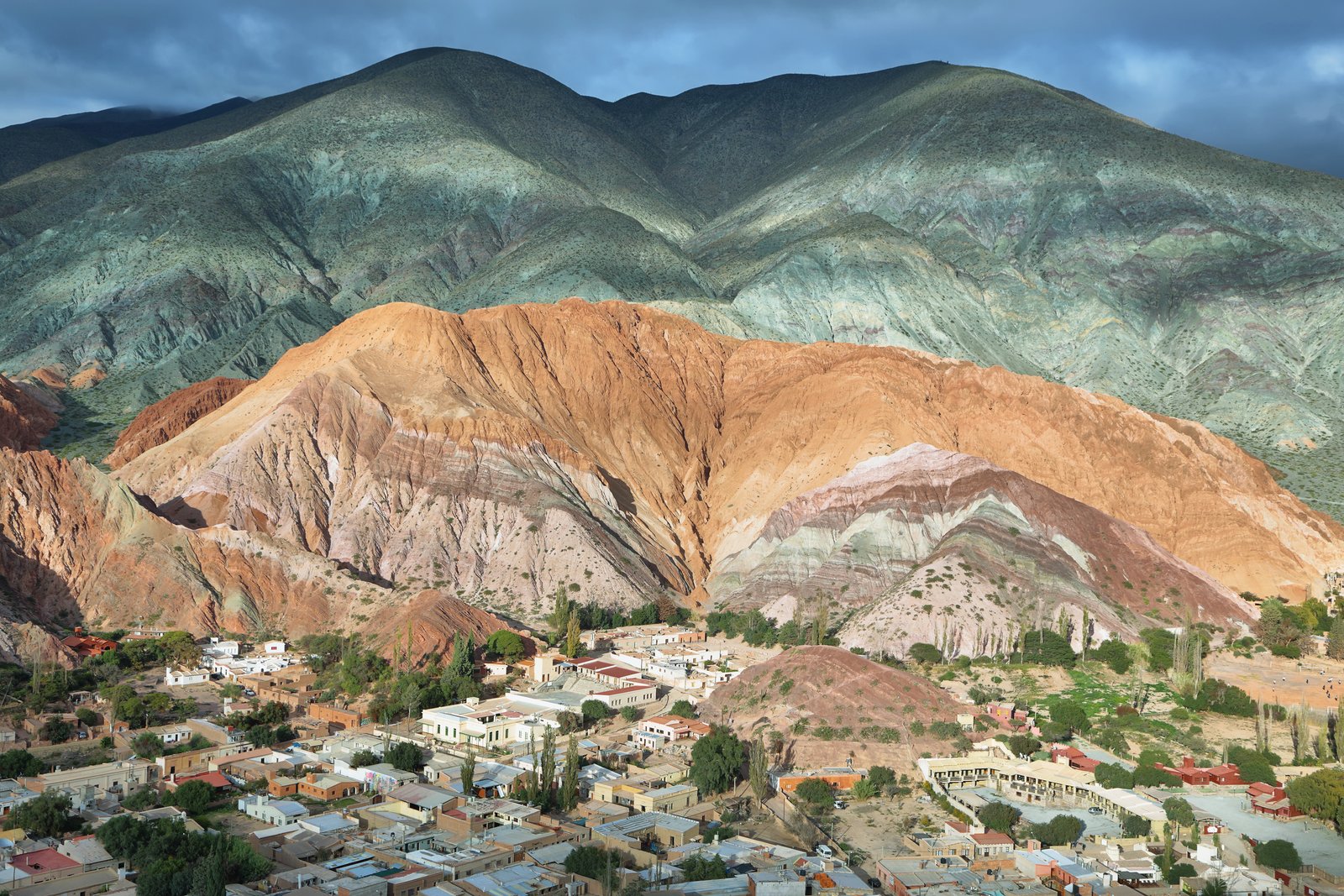
Quebrada de Humahuaca: Complete 2026 Guide — What to See, How to Get There & Where to Stay
Updated guide to the Quebrada de Humahuaca. UNESCO Heritage, towns, routes, accommodation and practical tips for your Jujuy trip.
Read more →
Salta & Jujuy in 5 Days: Complete Day-by-Day Itinerary
Optimized itinerary for touring Salta and Jujuy in 5 days. Routes, accommodation, transport and updated 2026 budget.
Read more →High-Altitude Wines of Jujuy: Quebrada de Humahuaca Wineries and the Secrets of Andean Malbec
Jujuy's high-altitude wines come from vineyards above 2,600 meters in the Quebrada de Humahuaca. Complete guide: wineries, altitudes, grape varieties, visits and where to buy.
Read more →