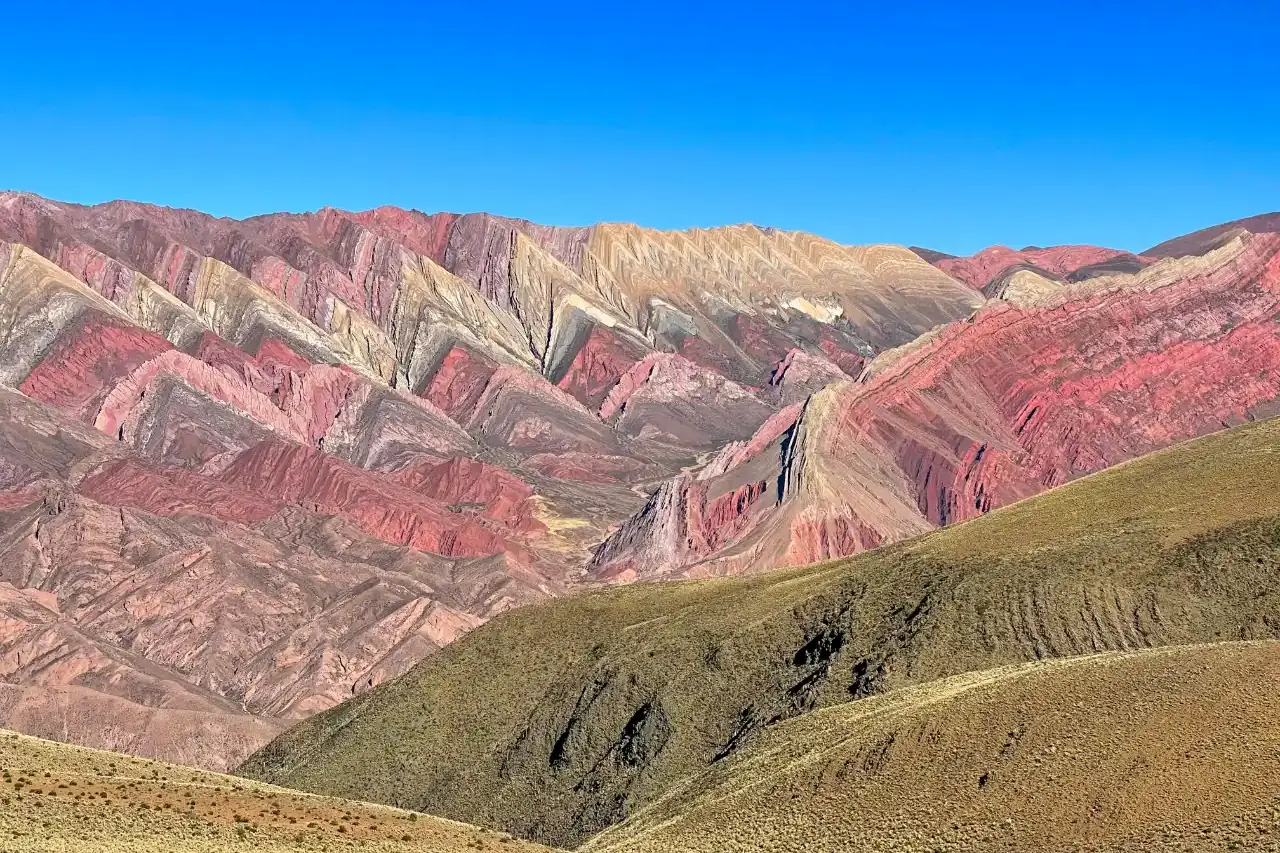
Humahuaca has a cold, dry high-altitude climate: at 2,939 m (9,642 ft) it is the coolest of the larger towns in the Quebrada de Humahuaca. Afternoons are mild almost all year, with highs of 20 to 24 °C (68 to 75 °F), but in winter the average low is about -3 °C (27 °F) and it freezes almost every night, so temperatures drop more than 20 °C (36 °F) between afternoon and dawn. It gets little rain, about 173 mm (6.8 in) a year, nearly all between December and March, the rainy season.
Below you will find Humahuaca weather month by month from the station of Argentina's National Weather Service (SMN), what to pack (seasons are reversed from the Northern Hemisphere), the best time to go, road conditions to Hornocal and Iruya in the rain, and how to read the forecast and alerts. For the rest of the province, see our guide to the best time to visit Jujuy.
What Humahuaca's climate is like
Humahuaca has a cold high-desert climate (BWk in the Köppen classification) with two clear seasons: a mild summer with thunderstorms, December to March, and a dry, clear winter with frosts the rest of the year. The SMN station that operated in town (2,980 m / 9,777 ft, 1961-1970 series) gives these figures:
- 221 clear-sky days a year and only about 26 days with precipitation.
- Around 112 frost days a year, nearly all between May and September: in July it freezes on 25 of 31 nights on average.
- An average annual temperature of 12 °C (54 °F), with extremes of 31.9 °C (89 °F) in January and -13.9 °C (7 °F) in July in that series.
- Low humidity, around 45% in winter.
Outside that series it has been colder still: Jujuy's Ministry of Culture and Tourism records a low of -18 °C (0 °F) in July 2010. Snow, by contrast, is rare in town, though more frequent on the heights around it.
Humahuaca sits about 475 m (1,560 ft) higher than Tilcara and you notice it: summer afternoons are a little cooler and nights colder. If you are coming from the south, our Tilcara weather guide shows the difference.
Humahuaca weather month by month
Averages from the SMN station in Humahuaca (2,980 m / 9,777 ft, 1961-1970), released by Argentina's Mining Secretariat. Values are rounded.
- January: high 24 °C (75 °F) / low 8 °C (46 °F), rain 40 mm (1.6 in)
- February: high 23 °C (73 °F) / low 9 °C (48 °F), rain 48 mm (1.9 in)
- March: high 24 °C (75 °F) / low 7 °C (45 °F), rain 26 mm (1.0 in)
- April: high 23 °C (73 °F) / low 3 °C (37 °F), rain 4 mm (0.2 in)
- May: high 22 °C (72 °F) / low -1 °C (30 °F), rain 0 mm
- June: high 20 °C (68 °F) / low -3 °C (27 °F), rain 0 mm
- July: high 20 °C (68 °F) / low -3 °C (27 °F), rain 0 mm
- August: high 21 °C (70 °F) / low -2 °C (28 °F), rain 1 mm (0.04 in)
- September: high 23 °C (73 °F) / low 1 °C (34 °F), rain 1 mm (0.04 in)
- October: high 24 °C (75 °F) / low 3 °C (37 °F), rain 1 mm (0.04 in)
- November: high 24 °C (75 °F) / low 6 °C (43 °F), rain 18 mm (0.7 in)
- December: high 24 °C (75 °F) / low 8 °C (46 °F), rain 34 mm (1.3 in)
How to read the list: highs barely change through the year, from 20 to 24 °C (68 to 75 °F); it is the lows that swing. From May to August the average low is below freezing and frost is almost nightly. February is the wettest month at 48 mm (1.9 in), and from May to October it rains 1 mm or less a month. These are decades-old averages: use them to plan, and the forecast for the actual weather on your trip.
What to pack for Humahuaca
Think layers, and think about the morning chill, which is sharper in Humahuaca than elsewhere in the Quebrada.
- Summer (December to March): T-shirts for midday, a rain jacket for storms and something warm for the evening, with lows of 7 to 9 °C (45 to 48 °F).
- Fall (April and May): pleasant days and nights close to freezing. A fleece, a warm jacket and a beanie.
- Winter (June to August): sunny afternoons around 20 °C (68 °F), but dawns averaging -3 °C (27 °F) and sometimes far colder. A down jacket, thermal layers, a beanie and gloves. Heating matters, so check before you book.
- Spring (September to November): highs of 23 to 24 °C (73 to 75 °F) and cool nights; a mid-weight jacket is enough unless you head out early.
- All year: sunglasses, a brimmed hat, high-SPF sunscreen and lip balm.
For high-altitude trips, pack one more layer than you think you need. The viewpoint at Hornocal, the 14-colors mountain, is at 4,350 m (14,272 ft), with icy wind even in summer, and the road to Iruya crosses the Abra del Cóndor pass at about 4,000 m (13,100 ft).
The best time to visit Humahuaca for your plans
- For Hornocal and photography: May to October. The town's station logged more than 20 clear-sky days a month from April to October, against 9 or 10 in December and January. The best light at Hornocal is in the afternoon, and in summer that is exactly when clouds and storms tend to build and dull the colors.
- For Carnival: February. Humahuaca is one of the hearts of the celebration. In 2027 the opening ceremony (the desentierro) is on Saturday 6 February, Carnival Tuesday is the 9th and the closing burial is on Sunday 14. Just before, on Tuesday 2 February, the town honors its patron saint, the Virgin of Candelaria, with Mass and a procession that winds through the streets for hours. It is the wettest month, so pack a rain jacket. Everything about the festival is in our Jujuy Carnival guide.
- For fewer crowds: September to November, plus May and June before the Argentine winter school holidays, avoiding Argentine long weekends.
- For lower prices: those same periods. For July, Carnival and Easter, book early.
- If you feel the cold: October and November, with warm afternoons, nights above freezing and very little rain.
To choose a base for your dates, see our guide on where to stay in Humahuaca.
Roads in the rainy season: RN 9, Hornocal and Iruya
From December to March, afternoon storms fill the dry streambeds coming off the mountains with water, mud and rocks. The roads take the hit.
- RN 9: the paved highway south to Tilcara and San Salvador de Jujuy, and north to La Quiaca. For the 2026-2027 season, Argentina's national roads agency (Vialidad Nacional) launched a preventive El Niño plan in Jujuy, with machinery stationed in advance in Humahuaca, Tilcara, Volcán, Susques and Ledesma.
- RP 73 to Hornocal: a gravel road that turns muddy or closes after storms. Jujuy's provincial roads department has reported closures in past rainy seasons from flooding rivers, such as the Pucará at the turnoff to Coctaca. Ask at the tourist office or the bus terminal before heading up.
- Road to Iruya: the gravel route crosses rivers that rise in summer, and the provincial roads department has reported closures from the Río Grande flooding near Iturbe. In those months, take the bus and leave a spare day.
- Where to check: Vialidad Nacional posts national route conditions on its website (in Spanish) and answers on 0800-222-6272, a toll-free number within Argentina, Monday to Friday from 9 am to 5 pm. Jujuy's Road Safety Secretariat publishes a daily report covering provincial routes.
Avoid driving at night in the rain, never cross a dip with running water and, on winter mornings, watch for ice in shaded spots.
Frost, wind and UV
Frost. It defines Humahuaca's winter: from May to August it freezes on 20 to 25 nights a month. If you are driving, expect a frozen windshield; park in the sun or wait until mid-morning to set off.
Wind. At the town station the prevailing wind was from the south, blowing up the valley, with low average speeds, but in the afternoon a cold breeze picks up and temperatures drop fast. In August a warm, dry north wind can blow. On some days the Zonda arrives, a hot, dry downslope wind similar to a foehn or chinook: in October 2026 the SMN kept yellow Zonda alerts for several days for the Puna and mountain zones of Humahuaca, with gusts over 70 km/h (43 mph), dust and sudden temperature jumps. At Hornocal the wind is usually much stronger than in town.
UV radiation. At nearly 3,000 m (9,800 ft) the sun burns fast even when it feels cold. The SMN publishes a daily UV index forecast for solar noon; on the World Health Organization scale, 8 to 10 is very high and 11 or more is extreme. High-SPF sunscreen every two hours, UV-filter sunglasses and a hat, all year.
Humahuaca forecast and SMN weather alerts
For the weather in Humahuaca over the next few days, the reference is the SMN, Argentina's official weather service. Check it at smn.gob.ar by searching for the town or the nearest place listed, or in its free app, SMN: Tiempo y Pronóstico (in Spanish), with a 7-day forecast, alerts 24, 48 and 72 hours ahead, radar and notifications if you are in an area under alert.
How to use it to plan your day:
- Look at the low before the high: in winter it decides how much you need to wear for an early start.
- Chance of precipitation: the SMN shows it in bands, from nula (0%) and muy baja (up to 10%) to baja (10 to 40%), media (40 to 70%) and alta (70 to 100%). It is the likelihood of rain, not the amount.
- If afternoon storms are forecast in summer, explore town in the morning and save Hornocal for a day with a stable forecast.
- Check the wind too: above about 40 km/h (25 mph) the viewpoint gets very uncomfortable.
- Trust the first two or three days most and check again the night before.
SMN alerts cover heavy rain, thunderstorms, wind, Zonda, snow and extreme temperatures, with a color for each level: yellow (stay informed), the most common, for weather that could cause damage and briefly disrupt activities; orange (get prepared) for dangerous weather; and red (follow official instructions) for exceptional situations. In Jujuy they are issued by zone, such as Zona montañosa de Humahuaca (mountain zone) or Puna de Humahuaca; Hornocal and the road to Iruya are up high, so check both. Each alert explains what to expect, when and what to do. Very short-range warnings, valid for 1 to 3 hours, are only issued where there is radar coverage.
Be wary of other apps: in a mountain valley, global models can be off by several degrees. When in doubt, go with the SMN, which issues the official alerts. To plan each day, add our guide to things to do in Humahuaca.
Frequently Asked Questions
Ready to travel?
Compare hotels, car rentals and tours in Jujuy.
Related Articles
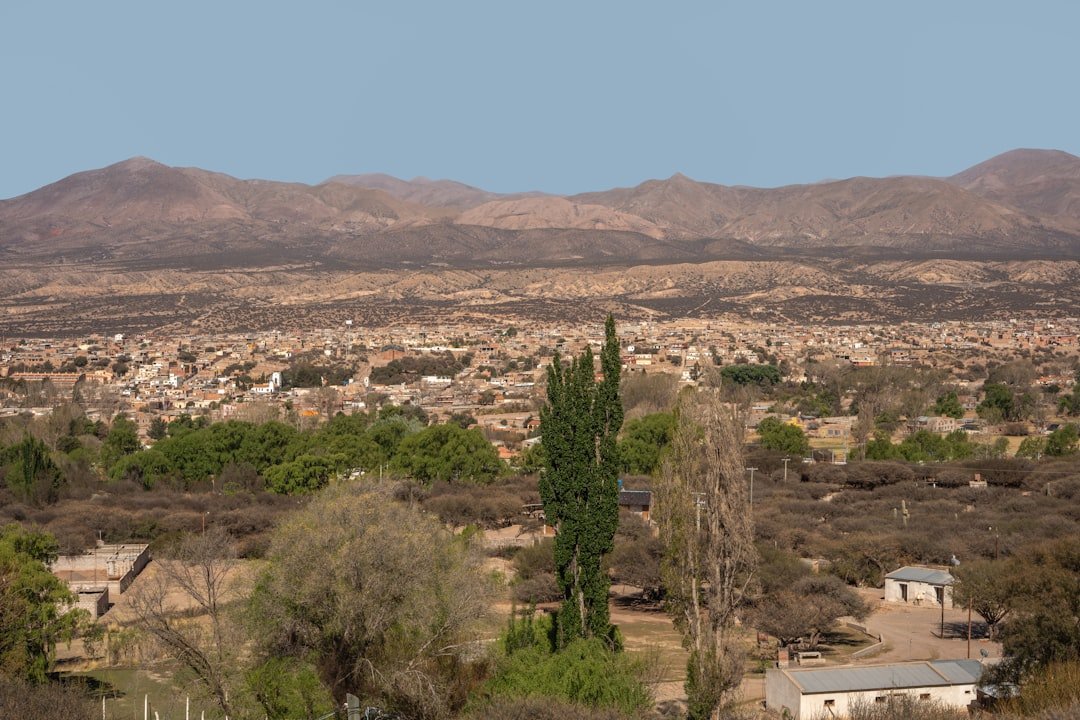
Altitude Sickness in Jujuy: How to Acclimatize and Not Ruin Your Trip
Practical guide to preventing and treating altitude sickness in Jujuy. Exact altitudes, day-by-day protocol, medications and warning signs.
Read more →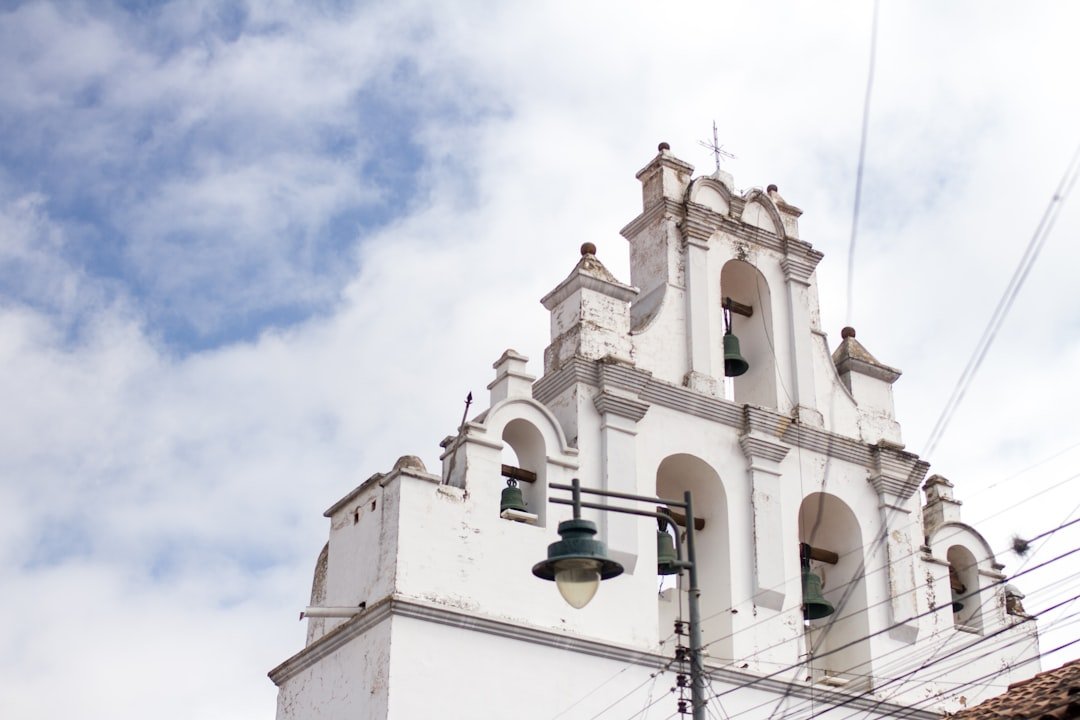
Humahuaca: What to See in the Quebrada's Main Town — Square, Town Hall and Andean Carnival
Guide to Humahuaca: the Cabildo with El Señor de la Sala, Independence Monument, crafts, Andean copla singing and the most authentic carnival in northwest Argentina.
Read more →Where to Stay in Humahuaca: Hotels, Hostels, Cabins and Uquía
Hotels in Humahuaca, cabins and hostels close to the Hornocal. The best areas in town, stays in Uquía and Huacalera, and when to book for Carnival.
Read more →