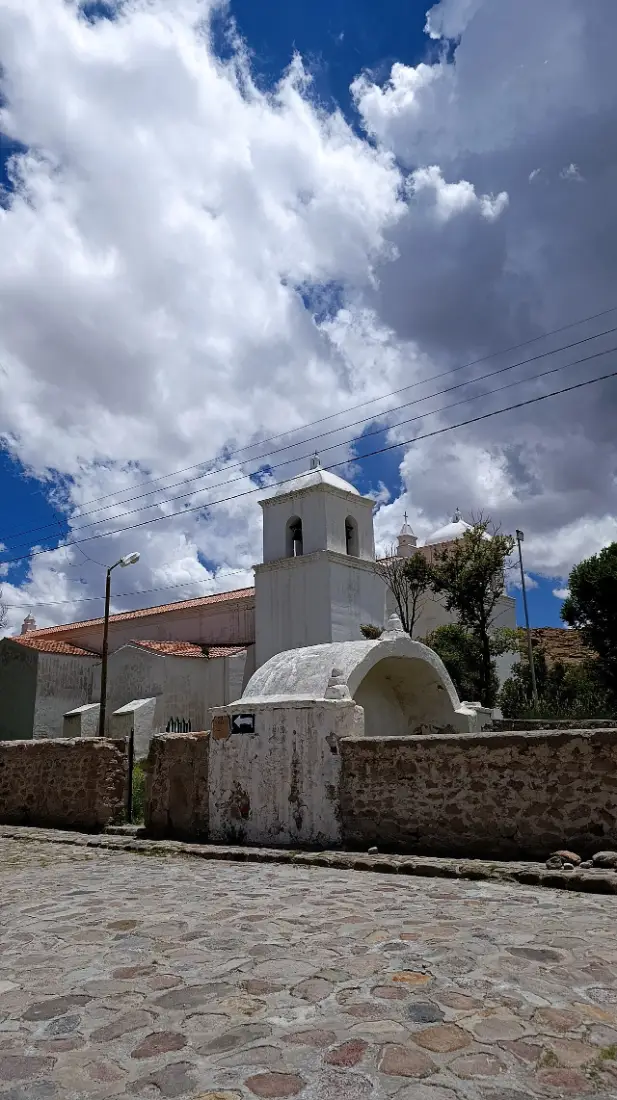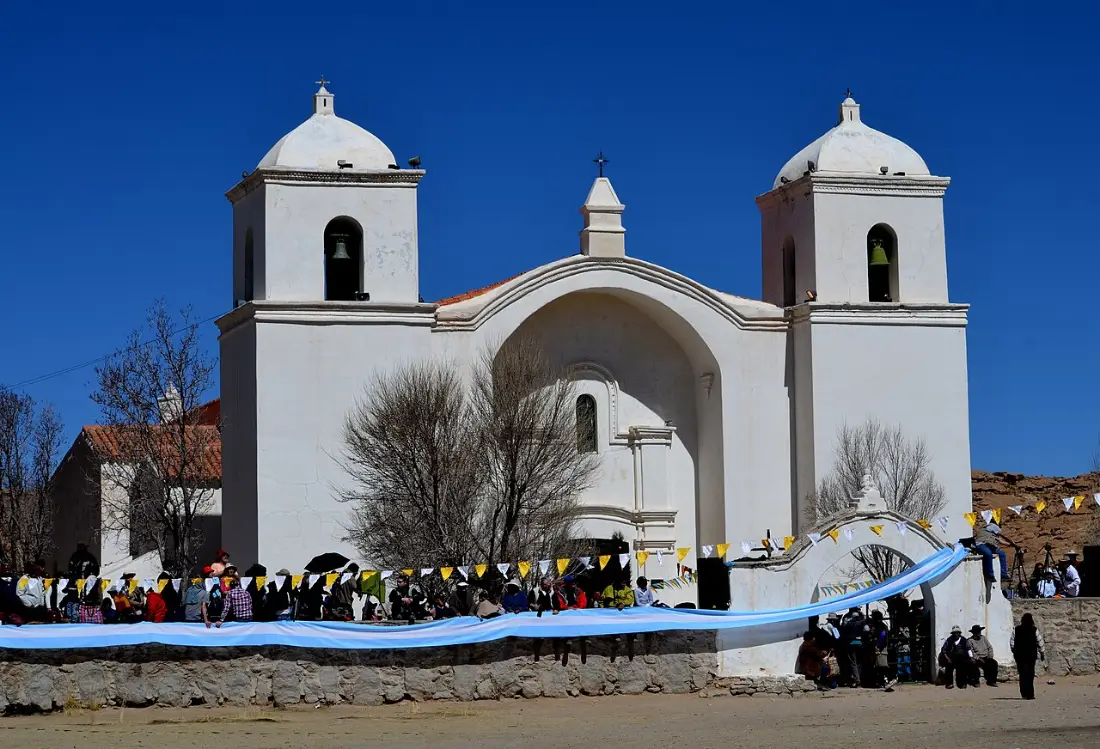
Casabindo church, the 'cathedral of the Puna', with people in the square
© Glfajim / Wikimedia Commons · CC BY-SA 3.0
Festivals & Events

Toreo de la Vincha in Casabindo: Jujuy's Bloodless Bullfight

Toreo de la Vincha in Casabindo, Jujuy: every 15 August locals snatch a coin headband from a bull's horns for the Virgin. Schedule, getting there, lodging.

When
15 August 2027, eve celebrations on 14 August (every year on 15 August)
Where
Casabindo, Jujuy Puna
See the Jujuy festival calendar

The Toreo de la Vincha takes place every 15 August in Casabindo, a village on Jujuy's high Puna plateau at more than 3,400 m (11,150 ft), as the climax of the feast of the Virgin of the Assumption. It is a bloodless bullfight: the bull is neither killed nor hurt. Instead, local toreros try to snatch a red headband (vincha) decorated with silver coins from its horns and offer it to the Virgin. In 2027, 15 August falls on a Sunday, with the eve celebrations on Saturday 14. The bullfight starts at around 2 pm, after Mass outside the church known as the Cathedral of the Puna and a procession led by feathered dancers and panpipe bands.

Casabindo is roughly 270 km (170 miles) from San Salvador de Jujuy, and the last 55 km (34 miles) are gravel from the town of Abra Pampa. This guide explains what the toreo is, the usual schedule, how to get there by car or on the overnight tours, where to sleep and how to cope with the August cold and altitude.

In this guide

What the Toreo de la Vincha is

It is the only bullfighting festival in Argentina, and Jujuy's Ministry of Culture and Tourism describes it as the only bloodless bullfight in South America. In 2019 Argentina's national Ministry of Culture added it to the country's register of intangible cultural heritage.

The idea is easy to explain and hard to pull off. In Plaza Pedro Quipildor, in front of the church, a bull is released with a red ribbon covered in silver coins tied between its horns. The torero, a local devotee rather than a professional bullfighter, provokes the bull and must take at least three charges before trying to grab the headband. If he snatches it before the third charge, the attempt doesn't count. Whoever wins the vincha carries it to the Virgin, whom villagers affectionately call the Mamita.

  • Bulls: in 2026 the organizers had about 12 animals lined up, lent by devoted local cattle owners.
  • Toreros: they sign up on the day itself, usually around 15 of them, according to the organizing committee.
  • Prizes: the best toreros receive prizes in the late afternoon.
  • The risk: it's all on the toreros' side. Knocks and tumbles are part of the show, while the bull is not meant to be harmed.

Local tradition links the event to Pantaleón de la Cruz Tabarca, a young villager who, the story goes, defied the bulls in front of the church in colonial times. The church committee still honors him every year.
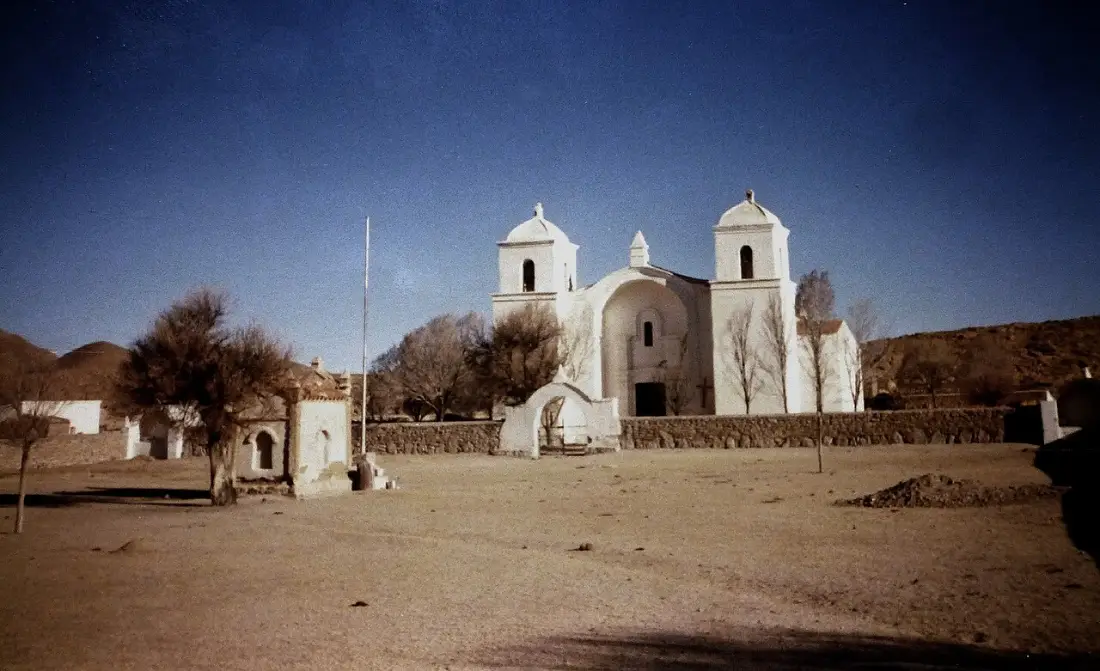
Casabindo square and church on the Jujuy Puna
Photo: Carlos Zito / Wikimedia Commons · CC BY-SA 3.0

The Cathedral of the Puna

Casabindo has little more than a hundred residents but a huge church. Nuestra Señora de la Asunción is built of stone, with a single nave, barrel vaults and twin towers flanking the entrance, set in a large courtyard enclosed by a dry-stone wall. Its size, and the crowds it draws every August, earned it the nickname Cathedral of the Puna. It was declared a National Historic Monument on 14 July 1941.

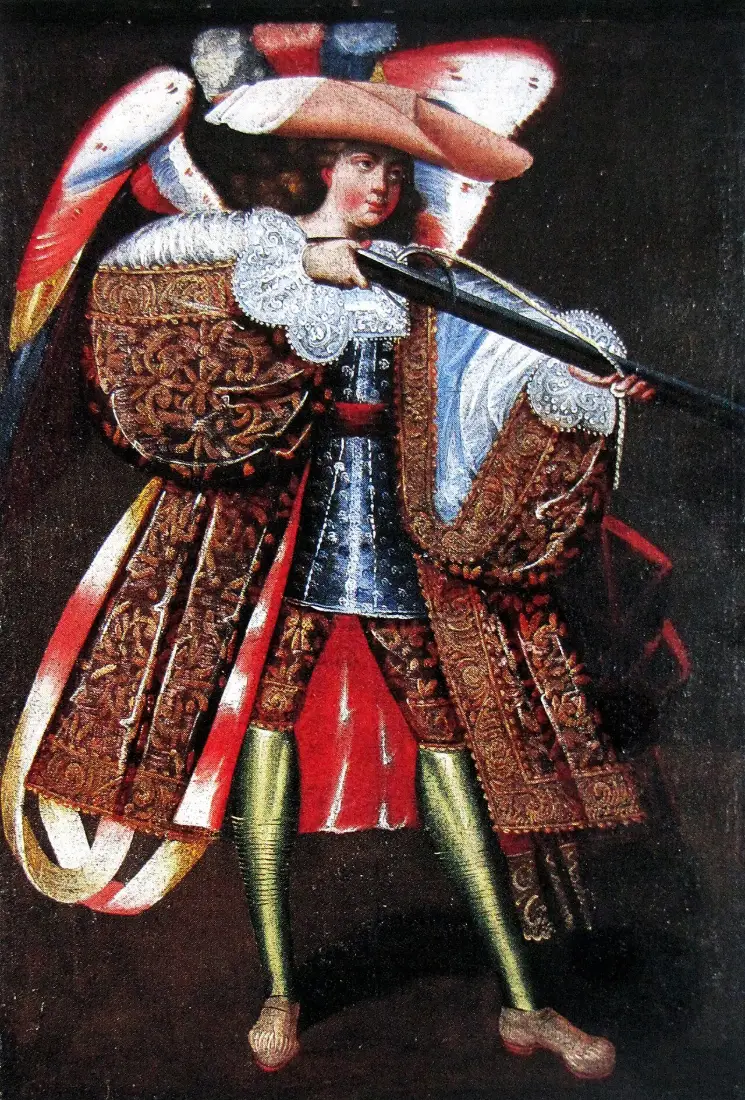
The current building was begun in the late 18th century at the initiative of Pedro Quipildor, the Indigenous chief and governor of the village, who gives his name to the bullfight square. Inside hangs a series of paintings of arquebusier angels, winged figures dressed as colonial soldiers. Only a handful of such series survive in South America's Southern Cone, including the one at the church of Uquía in the Quebrada and another at Calamarca in Bolivia.

If you want to see the interior properly, visit on another date. On 15 August the church overflows; in 2026 the main Mass was even moved outdoors because of the size of the previous year's crowd.

Painting of an arquebusier angel in Casabindo church
The church houses a series of painted arquebusier angels, like Uquía's.Photo: Unknown authorUnknown author / Wikimedia Commons · Public domain

The schedule: from dawn fireworks to the dance

The program changes little from year to year. This was the 2026 schedule published by Jujuy's Ministry of Culture and Tourism, a good guide for 2027:

  • 6:00 am: firecrackers and church bells.
  • 6:45 am: dawn prayers.
  • 8:30 am: welcome for officials, school groups and visitors in Plaza Pedro Quipildor.
  • 9:30 am: formal ceremony and flag raising.
  • 10:10 am: main Mass.
  • 11:00 am: procession with the Virgin and statues brought from neighboring villages.
  • 1:00 pm: chayada at the bull pen, a blessing with offerings by cattle owners, toreros and the committee.
  • 1:30 pm: the Virgin's blessing of the toreros.
  • 2:00 pm: the Toreo de la Vincha begins.
  • 5:30 pm: prizes and farewell to the visiting statues.
  • 8:00 pm: community dance in the village hall.

The eve has its own program. In 2026, 14 August opened at 10 am with an offering to the Pachamama (Mother Earth) and a gathering of copla singers, followed by a community lunch, a crafts fair, the arrival of statues from other villages, an evening Mass, bonfires, fireworks and a serenade to the Virgin. Arriving a day early means fewer crowds.

Samilantes (suri dancers) at a patron saint festival
Samilantes dance in suri (rhea) feathers at patron festivals in the Quebrada and the Puna.Photo: Valeria Patagua / Wikimedia Commons · CC BY-SA 4.0

Feathered dancers, toritos and panpipe bands

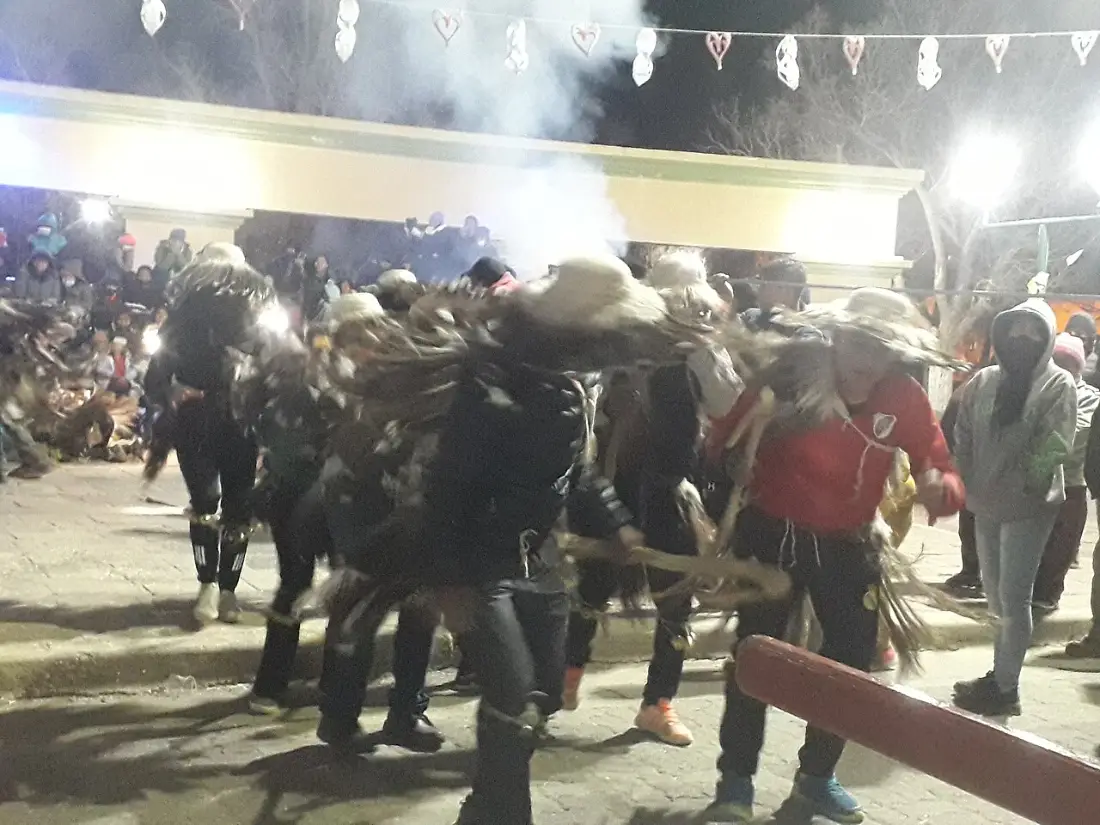
The 15 August procession is one of the most striking sights of the whole festival. Behind the Virgin come sikuri bands playing Andean panpipes and drums, plus a cast of characters rooted in the Andean world:

  • Samilantes: dancers covered in feathers of the suri, the lesser rhea of the high plateau, with bells on their legs. Their dance imitates the bird, which according to tradition grows restless when rain is coming, so it doubles as a prayer for a wet season.
  • Toritos: men in bull masks who dance their way through the crowd.
  • Caballitos and cuarteras: other traditional figures, walking alongside pilgrims fulfilling vows to the Virgin.

Samilante costumes are handed down within families and worn only on feast days, since the suri is protected and new feathers are no longer available. One important tip: many samilantes dislike close-up photos, especially during the procession. Ask first or shoot from a distance.

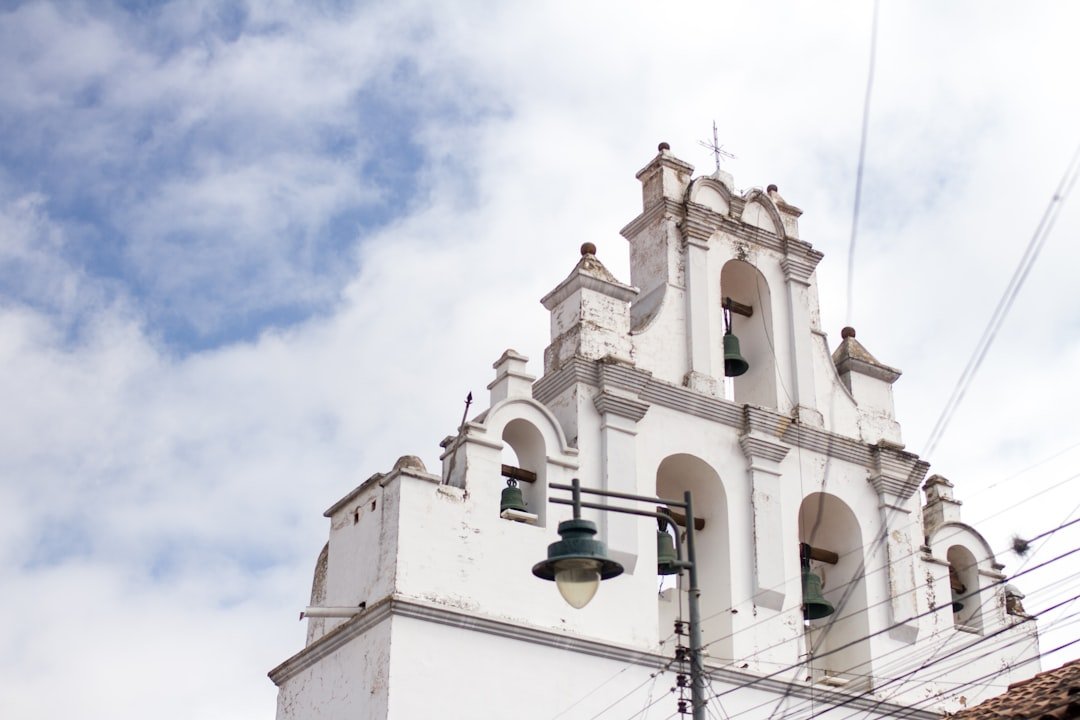
Casabindo church tower under a blue sky
Photo: Sararuna / Wikimedia Commons · CC BY 4.0

August on the Puna: Pachamama and other festivals

The toreo makes more sense alongside the rest of the month. August is the month of the Pachamama ceremony, when families and communities feed Mother Earth to give thanks and ask for a good farming year. In Casabindo that offering opens the eve of the feast, and the Virgin and the Pachamama are honored side by side, as they are across the Puna.

If you are planning several days in northern Jujuy, consider these dates too:

  • 1 August: Pachamama ceremonies across the province.
  • 16 August: in 2026 the community of Tambillos, near Abra Pampa, held its San Roque feast the day after the toreo.
  • 22 and 23 August: the Jujuy Exodus commemoration, with a torchlit historical march and a parade in San Salvador de Jujuy.

Every festival of the year is listed in our Jujuy events calendar.

Group of llamas grazing on the Puna

How to get to Casabindo

Casabindo is in the remote Cochinoca department. There are three sensible ways to get there:

  • By car from San Salvador de Jujuy or the Quebrada: drive north on paved Route 9 (RN 9) to Abra Pampa, about 220 km (137 miles) from the capital or 85 km (53 miles) from Humahuaca. There, take provincial road 11 (RP 11) southwest: about 55 km of gravel that takes 1.5 to 2 hours. Allow 4 to 5 hours in total from the capital.
  • From Purmamarca: Route 52 climbs the Cuesta de Lipán to the Salinas Grandes salt flats, as described in our Purmamarca to Salinas Grandes drive. From there, gravel provincial roads skirt the Guayatayoc lagoon to Casabindo, for example via Barrancas (Abdón Castro Tolay). It's a long, empty route: drive it in daylight with a vehicle in good shape.
  • On a tour: on the day of the festival, minibuses and coaches leave San Salvador de Jujuy at around 2 am and return in the afternoon. In August 2026, published fares ranged from roughly 55,000 to 85,000 Argentine pesos per person depending on the operator, and there were departures from Humahuaca at 6 or 7 am. Check that year's options at the bus terminal and with local agencies.

You can also take a regular bus to Abra Pampa and continue by remís, a local pre-booked taxi. Purmamarca has no gas station and neither does the final stretch, so fill up in Abra Pampa. On RP 11, dust from the convoy of cars cuts visibility badly, so drive slowly and avoid driving after dark. If you're going independently, renting a car in Jujuy is the most practical option; a pickup or high-clearance vehicle is best.

Llama in the Jujuy highlands

Where to stay for the Toreo de la Vincha

This is the hardest part to plan. Casabindo has almost no beds and they're taken months in advance. Abra Pampa, the nearest town, had 5 licensed lodgings with 169 beds according to the provincial tourism register, and they also sell out for 15 August.

  • Abra Pampa: the most convenient base, with a gas station, ATM, bus terminal and remís taxis. Book early and confirm by phone or WhatsApp.
  • Nearby communities: in previous years the provincial tourism office listed community homestays in Barrancas, Rinconadillas, San Francisco de Alfarcito and Sausalito, about half an hour from Casabindo. Ask the provincial tourism office for current contacts.
  • Humahuaca: far more choice, about two and a half hours from Casabindo. See where to stay in Humahuaca.
  • San Salvador de Jujuy: if you join an overnight tour, sleeping in the capital the night before and after is the simplest plan.

Camping at this altitude in August only makes sense with gear rated well below freezing and the community's permission. To compare prices and availability across the province, use the hotel search on this site.

Cold, altitude and tips for the day

15 August in Casabindo is a day of extremes. Before dawn and after 6 pm it is bitterly cold, below freezing; at midday the sun is fierce and the wind kicks up dust. Winter lows in the area have been recorded as low as -20 °C (-4 °F).

  • Clothing: thermal layers, a warm jacket, hat, gloves and closed shoes. By midday you'll peel half of it off.
  • Sun: high-SPF sunscreen, sunglasses and a hat.
  • Altitude: if you're flying in from sea level, don't go up to the Puna on the day you land. Drink plenty of water, eat light and walk slowly. More advice in our Jujuy altitude guide.
  • Cash: bring Argentine pesos from Abra Pampa or earlier. Food stalls and the fair work in cash.
  • Where to watch: the toreo is watched from stands and from the wall around the square. Arrive early and never stand in unprotected spots; the bull can charge close to the crowd.
  • Respect: this is a religious feast. During Mass and the procession, keep your voice down and don't step between the statues and the pilgrims.

Frequently Asked Questions

When is the Toreo de la Vincha in Casabindo?

Every year on 15 August, the Feast of the Assumption. In 2027 it falls on a Sunday; the bullfight starts at around 2 pm and the eve celebrations are on Saturday 14.

Is the bull killed or hurt?

No. It's a bloodless bullfight: the torero only has to remove the coin-covered headband from the bull's horns and offer it to the Virgin.

What is the altitude of Casabindo?

Casabindo sits at more than 3,400 m (11,150 ft) on the Jujuy Puna. It's best to acclimatize first in the Quebrada de Humahuaca.

How do I get to Casabindo from San Salvador de Jujuy?

Take Route 9 north to Abra Pampa, then about 55 km (34 miles) of gravel on provincial road 11. It's roughly 270 km (170 miles) and 4 to 5 hours in total.

Can I go to the Toreo de la Vincha without a car?

Yes. On 15 August, tours leave San Salvador de Jujuy in the early hours and Humahuaca early in the morning. You can also bus to Abra Pampa and take a remís taxi.

Where should I stay for the Toreo de la Vincha?

The closest options are Abra Pampa and a few community homestays nearby, which fill up early. Humahuaca and San Salvador de Jujuy have far more rooms.

What should I wear in Casabindo in August?

Warm layers, a hat and gloves for the freezing morning and evening, plus sunscreen and sunglasses for the strong midday sun.

Ready to travel?

Compare hotels, car rentals and tours in Jujuy.